An authoritative analysis of South Korea's manufacturing corridors, stringent quality control standards, and the operational transition toward Industry 4.0 smart factory integration.
South Korea stands as one of the world's most sophisticated hubs for advanced manufacturing, high-end consumer electronics (headquartered in Suwon, Gumi, and Yongin), premium cosmetics (K-Beauty clusters in Incheon and Seoul), and semiconductor logistics. Within this hyper-competitive industrial ecosystem, packaging is no longer merely a protective shell; it serves as a core extension of brand identity, high-precision component protection, and unboxing customer experience. Consequently, South Korean packaging converters and commercial printing plants are under immense pressure to source cutting-edge Printing Die Cutting Machines engineered by world-class factories that meet rigorous precision standards (+/- 0.075mm registration accuracy), high operational efficiency, and zero-defect output.
The Korean printing market is geographically concentrated across strategic industrial complexes: the Capital Region (Gyeonggi-do, Incheon, Ansan Smart Hub) specializing in high-tech display packaging and luxury retail cartons; the Yeongnam Complex (Busan, Daegu, Ulsan) focusing on heavy-duty industrial corrugated packaging and automotive spare part cartoning; and the Chungcheong Corridor (Cheonan, Cheongju) driving rapid demand in bio-pharmaceutical and battery box production. Facing persistent domestic minimum wage structural updates, rising raw material costs, and acute labor shortage in post-press operations, South Korean factory directors are aggressively upgrading from semi-automated platen cutters to fully integrated, intelligent full-adsorption flexo printing and automatic die-cutting lines.
Discover our primary product tier optimized for South Korean carton manufacturers, offering unparalleled register accuracy and intelligent flexographic integration.
Why full-vacuum adsorption and multi-servo registration control represent the definitive technical benchmark for modern South Korean box converting plants.
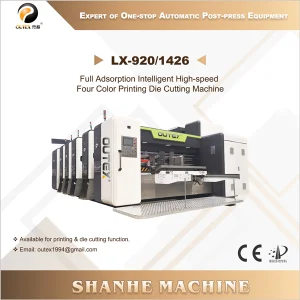
In traditional flatbed or basic mechanical roll feeding die cutters, sheet transport relies heavily on pinch rollers or physical pushers. When processing delicate high-graphics printed sheets, double-wall corrugated boards (A, B, C, E flutes), or ultra-thin boardstock down to 200 gsm, mechanical pressure causes structural flute crushing, surface scuffing, and registration slip. SHANHE MACHINE’s flagship LX-920/1426 Full Adsorption Series resolves this fundamental physical limitation through full-vacuum sectioned wind adsorption engineering.
By utilizing powerful, inverter-controlled centrifugal vacuum turbines beneath the entire sheet transport bed, every sheet is held completely flat against the conveyor belt with uniform negative pressure. This guarantees zero slippage during high-speed color overlay flexographic printing (up to 4 colors with doctor blade chamber systems) and subsequent rotary or inline die-cutting operations. Furthermore, the integration of Japanese Rexroth/Yaskawa multi-axis servo control systems allows each printing and die-cutting unit to perform real-time optical registration compensation with an accuracy of within ±0.075 mm.
| Performance Metrics | Legacy Mechanical Die Cutters | Conventional Flatbed Platen Cutters | SHANHE LX-920/1426 Full Adsorption Line |
|---|---|---|---|
| Max Operational Speed | 80 - 120 sheets/min | 120 - 150 sheets/min | 220 - 300 sheets/min |
| Feeding Mechanism | Mechanical Push-Bar / Friction Rollers | Front-Edge / Gripper Bar Feed | Full-Vacuum Sectional Sun-Feed / Adsorption |
| Register Accuracy | ±0.50 mm | ±0.15 mm | ±0.075 mm (Servo Optical Align) |
| Flute Preservation | High Flute Crushing Risk (15-20% loss) | Moderate Pressure Impact | Zero Flute Structure Degradation |
| In-line Processing | Single Operation (Die Cut Only) | Die Cut + Stripping | Flexo Printing + Slotting + Die-Cut + Stack |
| Job Changeover Time | 45 - 60 minutes | 25 - 35 minutes | < 10 minutes (Memory Touch Screen) |
Understanding how foreign procurement officers and South Korean plant managers evaluate machine longevity, energy footprints, and overall equipment effectiveness (OEE).
South Korea's Ministry of SME and Startups actively subsidizes Smart Factory initiatives. SHANHE machines come standard with Ethernet/IP, Modbus TCP, and IoT remote telemetry interfaces, enabling seamless ERP/MES data synchronization, OEE tracking, and predictive maintenance diagnostics.
Driven by South Korea's strict waste management laws (Resource Recycling Act), packaging plants require eco-friendly water-based flexo ink application, energy-saving frequency converters (reducing power consumption by 22%), and minimal paperboard trim waste.
With SKUs in Korean e-commerce (Coupang, Naver Shopping) multiplying rapidly, short-run packaging orders dominate. SHANHE’s computerized order storage system allows operators to recall stored die-cutting parameters and plate settings in seconds.
From raw paperboard reel slitting to high-speed laminating, flexo die-cutting, window patching, and crash-lock folding gluing.
Achieving optimal factory throughput requires eliminating bottlenecks between isolated machinery islands. SHANHE MACHINE designs integrated macro post-press workflow ecosystems tailor-made for South Korean packaging factories. The schematic below illustrates our high-efficiency production architecture:
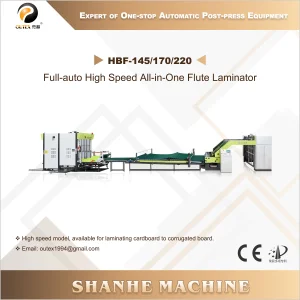
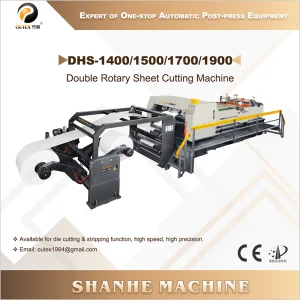
Raw cardboard or printed top sheets are precise-cut using the DHS Double Rotary Sheet Cutting Machine and paired with corrugated single-facers via the HBF Full-Auto High-Speed Flute Laminator, delivering flat, zero-bubble laminated boards at speeds up to 200 m/min.
Laminated boards enter the LX-920/1426 Four-Color Printing Die-Cutting Machine. Full vacuum suction ensures flawless 4-color flexo graphic transfer, inline scoring, and high-impact rotary die-cutting with dynamic vibration waste stripping.
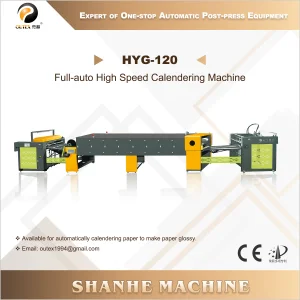
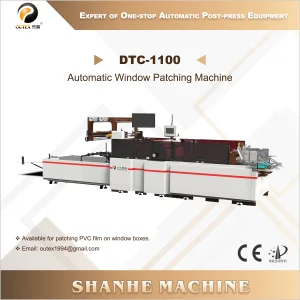
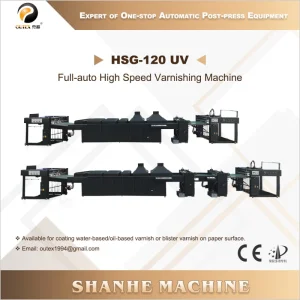
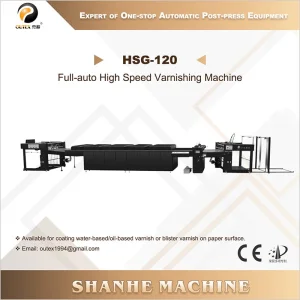
For cosmetic and electronic retail packaging, sheets pass through the HSG-120UV High Speed Varnishing Machine or HYG-120 Calendering Machine for high-gloss protection, followed by precision film patching on the DTC-1100 Dual-Channel Window Patching Machine.
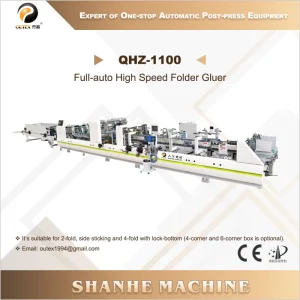
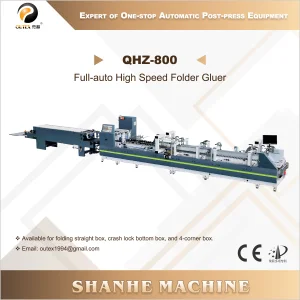
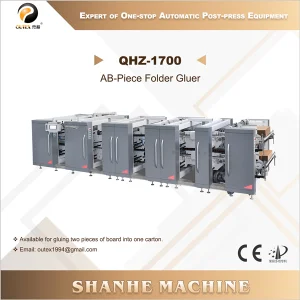
Final blanks are fed into the QHZ-1100 Full-Auto High Speed Folder Gluer, executing 2/4-fold, crash-lock bottom, and 4/6 corner box gluing with inline cold/hot melt adhesive tracking, outputting bundled retail-ready cartons.
Dedicated service infrastructure designed specifically for Korean manufacturing operators, guaranteeing maximum plant uptime and safety standard adherence.
All electrical cabinets, wiring looms, PLCs, and safety light curtains shipped to South Korea fully conform to KC (Korea Certification) standard safety regulations and KOSHA industrial machinery guidelines.
We maintain localized consumable spare parts kits (die blades, suction belts, anilox rolls, rubber blankets) with direct express delivery to Incheon, Busan, and Gimpo within 24–48 hours.
Our bilingual field application engineers conduct hands-on installation, line calibration, and machine operator safety training in Korean/English, ensuring zero learning curve for your plant staff.
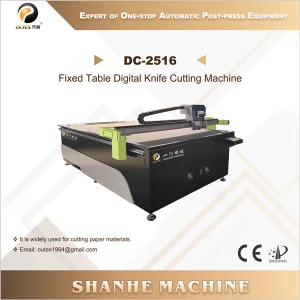
Explore our full line of digital knife cutters, high-speed flute laminators, varnishing lines, and heavy-duty sheet cutters.

Pioneering Next-Gen AI Vision Inspection, Dynamic Rotary Blade Positioning, and Ultra-Low Carbon Footprint Converting Technologies.
Integration of high-resolution 8K line-scan CCD cameras above the die-cutting station to detect color deviations, mis-registration, scuff marks, and partial die cuts in real-time at 300 meters per minute, automatically marking or ejecting defective sheets.
Eliminating manual operator alignment through robotic arm die-cylinder loading and magnetic auto-clamping systems. This innovation cuts die setup times from 20 minutes down to under 3 minutes for high-mix low-volume Korean packaging orders.
Implementation of kinetic energy recovery systems (KERS) on heavy die-cutting platen drives and suction blowers, feeding braking energy back into the factory electrical grid to help Korean manufacturers achieve RE100 zero-carbon targets.
Expert technical answers addressing lead times, shipping logistics to Busan/Incheon ports, KC safety certifications, and aftermarket service engineering.
South Korea's packaging market demands extreme dimensional stability and visual perfection for high-end electronics, cosmetics, and food packaging. Full-vacuum adsorption eliminates mechanical pinch rollers, preventing surface scratching on printed sheets and eliminating corrugated flute crushing (especially thin F/E micro-flutes). It maintains exact sheet registration (±0.075 mm) even at ultra-high production speeds up to 300 sheets/min.
We routinely ship directly from Shantou/Shanghai/Shenzhen ports directly to Incheon, Busan, or Pyeongtaek ports in South Korea. Sea transit typically takes only 3 to 5 days. Upon arrival, SHANHE engineering specialists perform on-site assembly, wiring integration, KC electrical safety testing, and operator training within 5 to 7 working days.
Yes. Every printing die-cutting machine configured for South Korea is built with KC-certified electrical components, Schneider/Siemens breakers, low-voltage control circuits, photoelectric safety curtains, and fully interlocked safety enclosures complying with KOSHA standards to ensure operator safety and smooth municipal factory inspections.
SHANHE MACHINE provides a comprehensive 12-month factory warranty covering all mechanical and electrical components. We provide 24/7 remote IoT cloud diagnostic troubleshooting, video-guided engineering assistance, and rapid dispatch of local replacement parts from our service partners in South Korea, keeping operational downtime near zero.
Absolutly. Our LX-920/1426 and HMC series die cutters are engineered to process a wide range of substrates, from 200 gsm solid paperboard up to 9 mm double-wall (A, B, C, E, F flute) corrugated board without requiring mechanical reconfiguration, making them ideal for versatile packaging converters.