
Precision-engineered post-press solutions delivering high-gloss mirror surface finish, exceptional rub resistance, and automated sheet control for high-volume conversion lines.



Understanding market migration, regulatory pressures, and the shift toward eco-friendly thermal finishing architectures across worldwide printing hubs.
The global packaging sector is undergoing a seismic paradigm shift driven by strict EU Single-Use Plastics Directives (SUPD) and global corporate ESG mandates. Traditional film lamination processes (such as thermal OPP/PET film laminating) face increasing environmental scrutinies due to recyclability barriers in municipal repulping facilities.
Consequently, high-speed automated calendering machines—capable of transforming aqueous (water-based) or solvent-free varnishes into high-gloss, ultra-smooth surfaces via thermo-mechanical compression—have emerged as the definitive sustainable alternative.
Contemporary consumer package goods (CPG) brands in cosmetics, pharmaceuticals, premium liquor, and consumer electronics require retail packaging that commands instant visual attention while maintaining physical integrity through international cold-chain and long-haul transport networks.
Calendering technology delivers gloss levels exceeding 90 to 95 Gloss Units (GU at 60°) while dramatically improving surface scuff resistance, water repellency, and anti-blocking attributes without inhibiting post-consumer repulping.
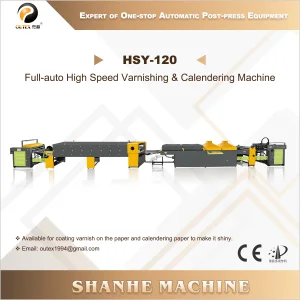
Standalone, manual-feed calendering operations are rapidly becoming obsolete due to high labor overhead, non-uniform thermal distribution, and elevated scrap rates. Modern converters are aggressively adopting inline systems (such as the SHANHE HSY-120 series) that seamlessly integrate primer coating, twin-tower metering, IR/UV curing, heated belt calendering, and high-speed non-stop stacking into a single continuous automated pass.
Analyzing thermal fluid dynamics, specular mirror cylinder fabrication, and pneumatic-hydraulic pressure nip control systems.
The heart of any industrial calendering machine is the chrome-plated specular heating cylinder. Manufactured from high-density forged alloy steel (such as 42CrMo), the cylinder undergoes multi-stage induction hardening, stress relieving, and precision deep-hole grinding. The outer surface is plated with hard industrial chromium (layer thickness 0.05–0.08 mm) and super-polished to a mirror finish with a surface roughness rating of Ra < 0.01 µm.
This extreme surface smooth quality is directly transferred under pressure to the molten varnish layer, eliminating surface micro-asperities and light scattering.
Maintaining temperature uniform across cylinder working widths up to 1450 mm is critical to prevent thermal expansion gradients and gloss color variations. Advanced calendering machines utilize dual-circuit thermal oil circulation systems or multi-zone electromagnetic induction heating coils.
By constantly circulating high-temperature synthetic thermal fluid through spiraled internal jacket channels at high flow velocities, temperature tolerances across the entire cylinder face are strictly maintained within ±1.0°C under continuous operating speeds of 100+ m/min.
| Parameter / Mechanical Spec | Standard Commercial Calender | SHANHE HYG / HSY Industrial Series | Impact on Finishing Quality |
|---|---|---|---|
| Cylinder Surface Roughness (Ra) | Ra 0.05 – 0.08 µm | Ra < 0.01 µm (Mirror Surface) | Eliminates light scatter; achieves 95+ GU mirror finish. |
| Thermal Control Precision | ±3.0°C – ±5.0°C | ±1.0°C (Closed-loop Thermal Oil) | Prevents varnish blistering, yellowing, or uneven gloss. |
| Nip Pressure Regulation | Manual Mechanical Screw | Hydraulic Proportional Servo Control | Ensures uniform pressure across 1200mm+ paper widths. |
| Calendering Belt Material | Standard Seamless Fabric | Imported High-Temp Stainless Steel / Composite | Long service life; zero joint marks on finished sheets. |
| Operating Linear Speed | 30 – 60 m/min | Up to 100 – 120 m/min | Doubles production throughput for large packaging plants. |
How intelligent sensors, water-based chemistry, and automated line synchronization are defining the next generation of post-press machinery.
Regulatory frameworks across Europe and North America have placed strict volatile organic compound (VOC) limits on packaging converters. Modern calendering machines are optimized to process high-solid water-based acrylic emulsions. By deploying ultra-long infrared (IR) drying tunnels combined with hot-air knives prior to the heated nip, water molecules are entirely evaporated, leaving a clear, resilient thermoplastic resin film ready for thermal glass-polishing.
Leading calendering installations now integrate inline non-contact spectrophotometers and laser gloss sensors. These devices constantly scan the web surface post-calendering, feeding real-time gloss data back to the central PLC. If deviations occur due to paper batch absorbency changes, the system automatically adjusts hydraulic pressure micro-valves and heating zone temperatures to maintain exact target GU levels.
Energy consumption represents a significant operational cost in thermal calendering. Modern machines implement regenerative heat exchangers that capture exhaust air from IR drying hoods to pre-heat incoming ambient air. Furthermore, the transition from traditional electric immersion heaters to high-frequency electromagnetic induction coils reduces thermal warmup times from 45 minutes to under 10 minutes while cutting electrical energy consumption by up to 28%.
Tailoring press settings, cylinder temperatures, and chemistry for distinct industrial converting sectors.
Operational Challenges: Pharmaceutical packaging demands zero migration, strict anti-counterfeiting print clarity, and 100% rub resistance against high-speed automated cartoning lines.
Calendering Solution: Water-based barrier varnish calendering applied on SBS/FBB paperboards. Cylinder temperature maintained at 110°C with 15 MPa nip pressure guarantees a smooth, non-tacky finish that allows precise optical barcode scanning and braille embossing without cracking the varnish layer.
Operational Challenges: Extreme aesthetic demands featuring metallic inks, deep multi-level embossing, and spot UV accents over rich solid background colors.
Calendering Solution: Double-pass inline varnishing and calendering systems. The initial pass seals board porosity, while the second pass applies a high-refractive calendered gloss layer. The ultra-smooth substrate allows subsequent hot foil stamping and die-cutting with razor-sharp edge definition.
Operational Challenges: Direct/indirect food contact compliance, grease resistance, water vapor barriers, and full compostability/recyclability.
Calendering Solution: Deployment of bio-based functional polymer coatings processed through high-pressure mirror calender rolls. The process seals paperboard micropores, creating a hydrophobic oil-resistant barrier replacing traditional PE extrusion lamination.
Bridging offset press output with high-speed surface finishing, die-cutting, and box folding operations.
Printed sheets from offset or digital presses are fed via non-stop stream feeders into a high-precision flexographic or gravure coater. A sealing primer is applied to seal the paper fibers and prevent varnish sink-in.
The sheet passes through a second coating tower applying a heavy laydown of water-based or solvent calendering varnish. It immediately enters an elongated drying bridge equipped with twin-air velocity knives and regulated IR lamps to evaporate all carrier liquids.
The dry coated sheet enters the calendering module, pressed firmly between the mirror chrome heating cylinder and a resilient pressure roller or circulating belt under hydraulic pressures reaching up to 20 MPa at 120°C.
Calendered sheets are rapidly cooled via internal chilled rolls to stabilize the gloss layer, then stacked using pneumatic side joggers before transferring directly to automatic die-cutting and folder-gluer lines.
Where post-press finishing technology is heading: Digital spot calendering, IoT predictive maintenance, and zero-carbon thermal engineering.
Integration of vibration sensors, acoustic emission monitors, and thermal imaging cameras on cylinder bearings and heating jackets. Machine PLCs upload telemetry data to cloud platforms, predicting bearing wear and heating element degradation before unplanned downtime occurs.
Development of inkjet-based thermally responsive polymer jetting coupled with segmented micro-calendering rollers. This allows packaging converters to apply tactile, mirror-gloss contrast effects to localized package elements without physical die plates or specialized gravure cylinders.
Complete elimination of liquid thermal oils through advanced direct-drive magnetic induction cylinders paired with solid-state heat pipes. Achieves instantaneous temperature change capabilities, sub-half-degree zone accuracy, and zero risk of fluid leaks or fire hazards.
Detailed engineering and operational answers for plant managers, procurement directors, and chief process engineers.
A standard UV coater applies a liquid UV-curable resin that is leveled via surface tension and instantly cured using high-intensity ultraviolet lamps. While fast, UV coatings can exhibit minor surface ripples (orange-peel effect) and are often difficult to recycle or fold without micro-cracking.
A calendering machine applies heat and immense mechanical nip pressure (hydraulic/pneumatic) to a thermoplastic or water-based coated paperboard using a mirror-polished chrome heating cylinder (surface roughness Ra < 0.01 µm). This physical compression flattens the varnish layer into a perfectly smooth mirror surface, resulting in higher specular gloss (>95 GU), superior tactile smoothness, and enhanced board flexibility without film cracking.
Water-based acrylic calendering varnishes (high-solid formulations) provide the optimal balance of eco-friendliness, repulpability, and gloss depth. Solvent-based calendering varnishes (nitrocellulose base) offer extreme gloss levels but require explosion-proof machine configurations and solvent recovery systems. Specialized UV-calendering coatings are also used where instant chemical resistance and zero drying tunnel footprint are required.
If cylinder heating is non-uniform or fluctuates by more than ±3°C, paperboard moisture content changes unevenly across the web width. This leads to sheet curling, wavy edges, or tail-edge register shifts during subsequent die-cutting operations. SHANHE's closed-loop thermal oil circulation systems maintain exact ±1.0°C thermal stability, ensuring perfectly flat, dimensionally stable sheets post-finishing.
Yes. However, recycled fibers exhibit higher surface porosity and shorter fiber lengths compared to virgin SBS/FBB boards. To achieve a mirror finish on recycled stocks, a dual-head inline line (such as the SHANHE HSY-120 series) is recommended to apply a primer sealing layer before applying the top calendering coat. This prevents varnish sink-in and guarantees uniform gloss retention.
1. Daily cleaning of the chrome surface using non-abrasive liquid solvents and soft lint-free cloths to remove varnish residue.
2. Periodic inspection of hydraulic nip pressure balance using electronic pressure sensing strips.
3. Rotary joint fluid seal replacements on thermal oil circuits every 4,000 operating hours.
4. Maintaining cleanroom-grade filtration on air knives and cooling belts to prevent airborne dust particles from pitting the mirror roll face.
Calendered paperboards achieve gloss and barrier performance comparable to traditional plastic film lamination (OPP/PET). Because calendered water-based coatings are extremely thin (typically 3–6 g/m²) and repulpable, the resulting packages can be deposited directly into standard paper recycling streams, supporting global circular economy objectives.
Explore our complete range of film laminators, die cutters, hot stampers, and folder gluers engineered for world-class packaging converters.