Explore our flagship post-press finishing systems engineered for extreme accuracy, continuous operating duty, and integrated packaging production lines.
A comprehensive technical analysis of pneumatic pressure dynamics, thermal management, and precision mechanical alignment in modern post-press converting processes.
In high-end packaging conversion, the demand for intricate tactile textures, anti-counterfeiting micro-embossing, and deep blind debossing has rendered traditional mechanical toggle presses obsolete for sensitive substrates. While mechanical systems suffer from rigid pressure curves and hydraulic systems present risks of oil contamination and thermal degradation over continuous shifts, advanced Pneumatic Embossing Machines establish an optimized balance of controllable force vectoring, rapid cycle recovery, and pristine operation environments.
Modern industrial pneumatic embossing units utilize multi-stage compressed air actuation coupled with proportional pneumatic servo valves. This allows converter plant operators to program pressure ramp curves with micro-bar precision. Whether processing 80 gsm fine label papers, 600 gsm solid bleached sulfate (SBS) board, or heavy E-flute corrugated sheets, pneumatic drive mechanisms deliver identical force profile repeatabilities across millions of impressions without mechanical backlash or hydraulic fluid heat dissipation issues.
Achieving crisp, structural embossing depth without fracturing paper fibers requires the synchronized interaction of static pneumatic pressure and localized thermal transfer. Industrial pneumatic embossing systems manufactured by Guangdong Shanhe Industrial Co., Ltd. (SHANHE MACHINE) incorporate multi-zone electric heating plates governed by closed-loop PID controllers.
By maintaining thermal variance within ±1°C across the entire platen area, the cellulose molecules within the paperboard soften precisely at the moment of peak pneumatic cylinder stroke. This dual-parameter calibration prevents surface crazing, eliminates micro-cracking on laminated film layers, and ensures that three-dimensional sculptural dies transfer maximum relief detail at full production speeds.
Macro-economic shifts, sustainability mandates, and premium consumer packaging trends are driving hardware innovation across worldwide converting markets.
Global consumer brands are eliminating plastic films and laminates in favor of recyclable paperboard. Pneumatic micro-embossing provides visual sheen, pattern contrast, and premium tactile grip directly onto uncoated papers without adding non-recyclable coatings.
Pharmaceutical, luxury spirit, and electronics markets require micro-structured tactile security features. High-tonnage pneumatic embossing presses can transfer sub-micron optical refractive structures directly onto paper substrate surfaces for immediate authenticity verification.
With SKU proliferation and targeted seasonal marketing, packaging runs are shorter. Modern pneumatic systems replace manual die shimming with pneumatic quick-clamp honeycombs and digitized pressure recall presets, cutting setup times by up to 65%.
How international tier-1 packaging converters evaluate machinery vendors to minimize Total Cost of Ownership (TCO) and maximize Overall Equipment Effectiveness (OEE).
When enterprise procurement departments acquire capital equipment for high-volume post-press operations, financial metrics extend far beyond initial machine acquisition cost. Strategic procurement teams evaluate key technical operational parameters:
Traditional pneumatic machines often waste energy through continuous air venting. Advanced SHANHE equipment utilizes closed-loop pneumatic energy recovery circuits, reducing compressed air demand per sheet cycle by 28% and lowering annual factory energy overhead.
In high-speed folding carton lines, a 0.5% sheet waste reduction translates to tens of thousands of dollars in annual paperboard savings. Precise optical registration and smooth pneumatic pressure dwell times prevent sheet tearing and misregistration during emergency line stops.
Industrial machinery must conform strictly to international regulations. Export models feature CE certification, ISO 9001 manufacturing quality control, dual safety light curtains, and Siemens/Schneider PLC automation architectures recognized by global plant maintenance teams.
To eliminate downtime risks, pneumatic valves, air cylinders, bearings, and electronic sensors are sourced from top-tier international OEMs (Festo, SMC, NSK, Omron). This ensures replacement parts are locally accessible in North America, Europe, Southeast Asia, and Latin America.
Inside Guangdong Shanhe Industrial Co., Ltd. — Decades of specialized engineering infrastructure delivering global competitiveness.
China’s industrial transformation into a high-precision manufacturing powerhouse is exemplified in Guangdong’s advanced equipment manufacturing clusters. Founded in 1994, SHANHE MACHINE operates out of a state-of-the-art 34,175 square meter manufacturing campus in the Jinping Industrial Zone, Shantou, Guangdong.
Every critical structural component — including heavy-duty platen frames, main drive shafts, and pneumatic manifold blocks — is machined in-house using heavy multi-axis CNC gantries. This guarantees geometric tolerance retention over decades of continuous operation.
Located in the heart of China’s premium machinery manufacturing corridor, SHANHE leverages raw material logistics, specialized metallurgical heat-treatment services, and rapid component prototyping to deliver custom line configurations within short lead times.
With direct import and export rights and dedicated global technical installation teams, SHANHE delivers seamless machinery transport, customs handling, direct factory commissioning, and operator training to plant locations worldwide without agent markups.
Understanding the mechanical equations, force distribution, and pneumatic control loops that govern high-speed post-press finishing systems.
The total force applied in a pneumatic embossing press is governed by the total surface area of the main pneumatic actuator piston array combined with working gauge pressure. Expressed mathematically:
Total Embossing Force (F) = P × A × η
Where P = Working Air Pressure (Bar), A = Cylinder Piston Surface Area (cm²), η = Mechanical Linkage Efficiency Coefficient
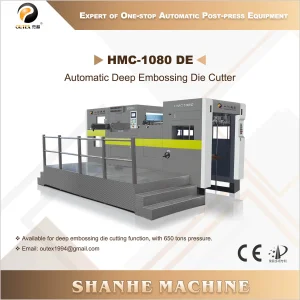
By utilizing high-pressure air intensification units, standard 6 to 8 Bar factory compressed air is converted locally within the machine circuit into high-density pneumatic thrust forces. This allows machines like the HMC-1080DE Automatic Deep Embossing Die Cutter to generate up to 650 Tons of total tonnage while maintaining instantaneous emergency pressure relief capabilities unavailable in purely mechanical flywheels.
High-speed pneumatic die cutting and embossing machines utilize lightweight, ultra-rigid carbon-fiber or alloy gripper bars driven by precision double-cam indexers. As paperboard enters the embossing station:
Precision embossing solutions tailored to high-value sector requirements across global packaging manufacturing hubs.
Requirement: Multi-level 3D sculptured embossing combined with registered foil stamping on metallic coated board.
Solution: Dual-use pneumatic deep embossing die cutters provide precise thermal regulation to emboss intricate lace micro-textures and brand logos without cracking UV coated surfaces.
Requirement: Heavy linen texture replication, deep crest embossing, and precise perimeter kiss-cutting on wet-strength textured label papers.
Solution: High-speed sheet-fed pneumatic embossing units equipped with fine pressure regulation guarantee uniform tactile feel across millions of spirits bottles.
Requirement: Strict compliance with international EN 15823 standards for raised Braille dot height consistency and anti-counterfeit micro-patterns.
Solution: Specialized pneumatic embossing toolholders maintain consistent Braille dot height across the entire sheet layout, eliminating compliance rejection risks.
Requirement: High-rigidity crushing-free embossing on laminated flute board for retail electronics and consumer goods.
Solution: Large-format pneumatic die cutting and embossing machines utilize wide-clearance platen openings and gentle pneumatic suction feeders to handle heavy flute stock cleanly.
Engineering parameters across SHANHE’s flagship post-press finishing and embossing series.
| Machine Series / Parameter | Max. Sheet Size (mm) | Min. Sheet Size (mm) | Max. Mechanical Speed | Max. Pressure / Tonnage | Target Substrate Range |
|---|---|---|---|---|---|
| HMC-1080DE Deep Embossing Cutter | 1080 × 780 | 400 × 360 | 6,000 sheets/hr | 650 Tons | 90–2000 gsm paperboard / Flute <4mm |
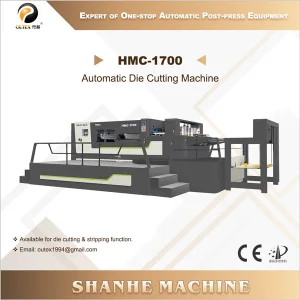
| HMC-1700 Automatic Die Cutter | 1700 × 1200 | 650 × 550 | 4,500 sheets/hr | 400 Tons | Cardboard >1.5mm, Corrugated E/B/C/N Flute |
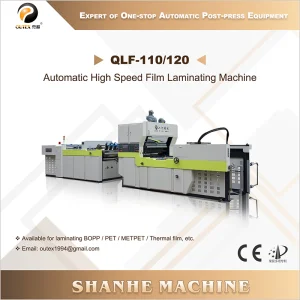
| QLF-110/120 High Speed Film Laminator | 1200 × 1080 | 350 × 350 | 100 m/min | Pneumatic nip pressure | 80–600 gsm paper with PET/BOPP film |
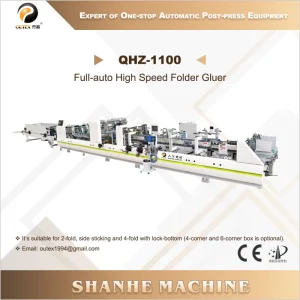
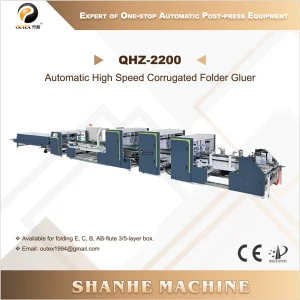
| QHZ-1100 High Speed Folder Gluer | 1100 × 1000 | 120 × 70 | 400 m/min | Pneumatic belt pressing | 210–800 gsm board, E/B Corrugated boxes |
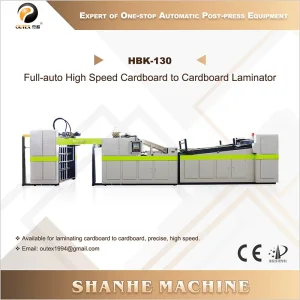
| HBK-130 Cardboard Laminator | 1300 × 1100 | 420 × 380 | 10,000 pcs/hr | Hydraulic/Pneumatic press | Cardboard to cardboard mounting (1-3mm) |
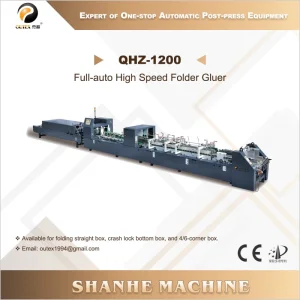
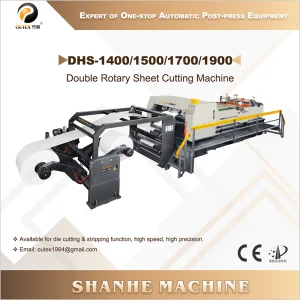
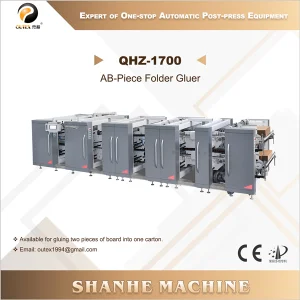
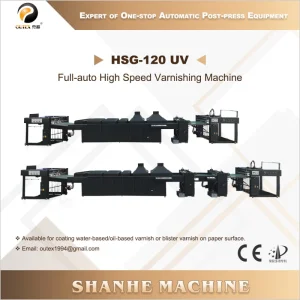
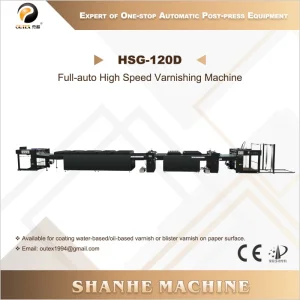
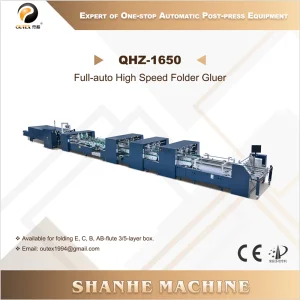
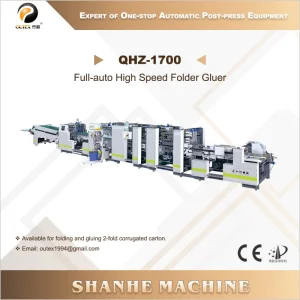
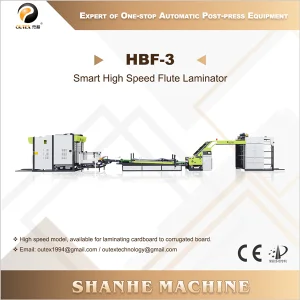
Complete your post-press automation line with our complementary high-speed converting systems designed for seamless integration.
Direct technical answers from SHANHE MACHINE’s chief engineering team regarding machine selection, plant installation, and operational maintenance.