
1. Global Industrial Landscape of Automatic Hot Foil Stamping Technology
In the contemporary post-press converting and luxury packaging sector, automatic hot foil stamping represents a core technology for adding tactile brilliance, visual appeal, and anti-counterfeiting security to paper products. As brand owners in cosmetics, premium spirits, tobacco, pharmaceuticals, and high-end electronics continually elevate aesthetic expectations, post-press equipment must achieve higher throughputs, ultra-precise registration, and zero-defect foil transfer dynamics.
Historically dominated by European machinery builders, the global market for platen hot foil stamping machines has undergone a structural transformation over the past two decades. Industrial packaging converters in Europe, North America, Latin America, and Southeast Asia are increasingly sourcing heavy-duty, high-precision automatic hot foil stampers from advanced OEM suppliers in China. This shift is driven by substantial improvements in Chinese mechanical design, servo-motor control integration, heating thermal stability, and overall Total Cost of Ownership (TCO).
2. Mechanical Engineering Innovations & Structural Core Design
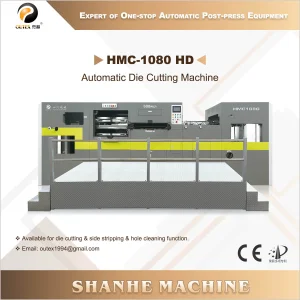
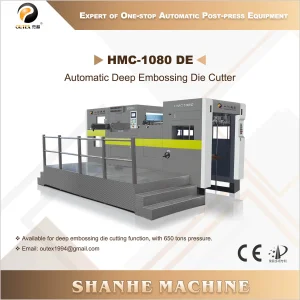
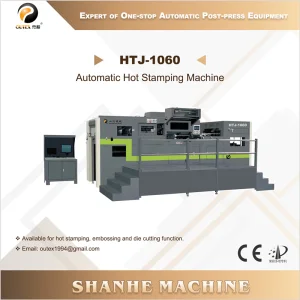
A high-performance automatic hot foil stamper (such as the HTJ-1060 or HMC-1080DE series) relies on rigid mechanical engineering capable of executing continuous die-cutting and thermal foil transfer under massive tonnage without frame deflection. Key architectural components include:
Heavy-Duty Platen Driving System
Constructed from high-tensile nodular cast iron (such as QT500-7 grade), the upper and lower platen frames are stress-relieved via heat treatment to guarantee structural stability under pressures up to 600 or 650 tons. The main drive mechanism employs precision worm gear pairs and crank toggle arms, delivering smooth power transfer, minimal vibration, and extended dwell time at maximum compression.
Multi-Zone Independent Thermal Control
Thermal accuracy is critical to prevent foil distortion, blistering, or incomplete release. Advanced hot foil stampers feature 12 to 20 individual heating zones managed by PID digital controllers. This configuration ensures uniform temperature distribution across the entire honeycomb plate (up to 120°C–160°C operating window) with tolerance variations constrained within ±1°C.
Multi-Axis Servo Foil Feeding & Rewinding
To eliminate expensive foil waste during long production runs, modern machines integrate multi-axis independent servo motors (such as Yaskawa or Siemens systems) driving longitudinal and transversal foil feeding channels. Computer-calculated foil-saving algorithms optimize step lengths, allowing variable foil stepping, skip-stamping modes, and simultaneous feeding of different foil roll widths.
Holographic & Security Stamping Capability
For anti-counterfeiting applications on pharmaceutical packages, tax stamps, and credit card stock, machines are equipped with optical sensors and registration software to track printed hologram registration marks, ensuring precise alignment of security holograms at high speed.
3. China Manufacturing Efficiency & Supply Chain Advantages
Guangdong Shanhe Industrial Co., Ltd. (SHANHE MACHINE), founded in 1994 and operating from a 34,175 m² modern manufacturing park in Shantou, Guangdong, exemplifies the global competitive edge of Chinese post-press OEMs. China’s packaging machinery sector provides several distinct supply chain advantages:
- Complete Vertical Integration: From heavy casting machining, CNC precision gear grinding, to electric cabinet wiring and final assembly, Chinese factories maintain localized control over 85%+ of machine component fabrication, drastically reducing lead times and manufacturing overhead.
- Rigorous CE Compliance & Quality Testing: Leading Chinese manufacturers implement strict ISO9001 quality management standards and international CE certification protocols. Prior to shipment, machines undergo continuous 72-hour load testing under high-speed operation.
- Exceptional Cost-to-Performance Ratio: Buyers secure premium industrial capabilities—such as 600-ton platen pressure, multi-axis servo foil feeding, and integrated stripping—at capital expenditure levels significantly lower than Western equivalents, optimizing payback periods (ROI).
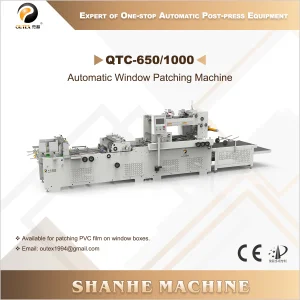
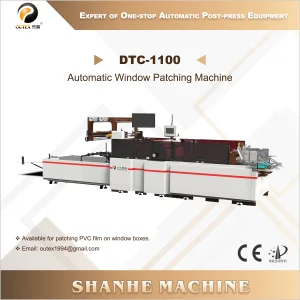
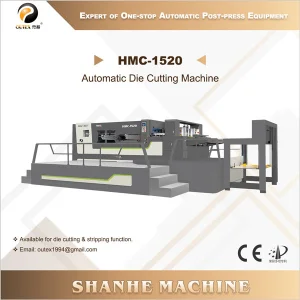
- Comprehensive Customization Capacity: Standard platen sizes (e.g., 1060mm, 1080mm, 1520mm) can be customized with dual-channel window patching units, flip-flop automatic stackers, inline calendering, or dedicated heavy embossing beds depending on substrate weight (from 90g/m² paperboard to 2000g/m² cardboard and corrugated board).
4. Substrate Compatibility & Localized Application Scenarios
Automatic hot foil stampers and platen die-cutters are deployed across diverse packaging and graphic art environments:
Luxury Cosmetics & Fragrance Packaging
Requires ultra-fine detail stamping, crisp micro-embossing, and flawless gold/silver mirror metallic transfer on coated folding cartons and soft-touch laminated paperboard.
Spirits, Wine & Tobacco Folding Boxes
Utilizes multi-color foil combinations, combination stamping dies (embossing + stamping in one hit), and anti-counterfeiting holographic marks to secure brand identity.
Pharmaceutical & Healthcare Packaging
Demands zero-error registration, Braille embossing integration, high-speed output, and full automated sheet sorting to comply with strict medical packaging standards.
Corrugated Retail & E-Commerce Display
Accommodates heavy E, B, F flute corrugated substrates and laminated boards up to 4mm thickness, delivering decorative metallic foil stamping for point-of-sale displays.
5. Industry Trends: Industry 4.0, Sustainability, and Smart Automation
As the printing and converting market advances, four macro trends are reshaping automatic hot foil stamper development:
- Digitalized Job Setup & Servo Autoloading: Modern machines integrate human-machine touch interfaces (HMI) that store hundreds of job parameters. Intelligent foil feeding programs automatically calculate optimal step length and tension control, cutting setup scrap by up to 40%.
- Eco-Friendly Foil Recyclability Alignment: Contrary to plastic laminates, metallic foil applied via hot stamping is extremely thin (typically 12 to 15 microns). Recyclability studies confirm that foil-stamped paper products remain fully repulpable and biodegradable. Modern machine pressure controls preserve sheet fibers, aiding circular economy goals.
- Inline Multi-Process Integration: Combining hot stamping, deep embossing, die-cutting, stripping, and automatic flip-flop stacking into unified, high-speed production lines reduces manual labor touchpoints and footprint requirements.
- IoT Remote Diagnostics & Predictive Maintenance: Industrial IoT gateways installed on post-press machinery allow centralized monitoring of thermal sensors, motor currents, lubricator pressure, and platen stress points, enabling proactive remote technical support.
6. Buyer’s Checklist: Procurement Criteria for Converting Facilities
When selecting an automatic hot foil stamper supplier in China, enterprise buyers should evaluate suppliers using the following critical metrics:
- Maximum Tonnage & Frame Structure: Confirm that rated tonnage (e.g., 600T or 650T) is validated through structural finite element analysis (FEA) to handle heavy embossing dies without frame flex.
- Foil Advance Capabilities: Verify the number of longitudinal and transverse foil shafts, rewinding units, and optical hologram detection setups.
- Feeding & Registration Precision: Ensure gripper bar chains, non-stop feeders, and side-lay sensors deliver registration precision within ±0.075mm under operational speeds exceeding 7,000 sheets per hour.
- After-Sales Ecosystem: Ensure the factory provides technical site planning, on-site commissioning, operator training, standard spare-parts kits, and remote diagnostic services.