In the rapidly evolving post-press finishing sector, the demand for high-precision, visually arresting luxury packaging has triggered a structural migration toward integrated Hot Foil Embossing Machines. As brand owners in cosmetics, premium spirits, pharmaceuticals, and luxury electronics fight for consumer attention on retail shelves, tactile elegance paired with metallic radiance has become the ultimate differentiator. Hot foil stamping—combined simultaneously with multi-level deep embossing—imparts a three-dimensional visual depth that digital printing methods cannot replicate.
Modern commercial packaging converters face a dual challenge: achieving micro-metric register accuracy across ultra-long production cycles while simultaneously adhering to strict environmental, social, and governance (ESG) frameworks. The modern hot foil embossing press is no longer merely a mechanical platen stamper; it is a cyber-physical system equipped with multi-zone intelligent thermal regulation, closed-loop servo foil stepping, and acoustic pressure diagnostics. Leading original equipment manufacturers (OEMs) like Guangdong Shanhe Industrial Co., Ltd. (SHANHE MACHINE) have spearheaded this transition by embedding 30+ years of heavy-duty engineering expertise into automated finishing architectures.
Tactile packaging surfaces increase consumer dwell time by up to 42%. By integrating thermal transfer metallic foil with sculptured 3D micro-embossing in a single pass, converters maximize profit margins per unit while reducing pass-through operational bottlenecks.
Engineered to process substrates ranging from delicate 80 g/m² paperboard to heavy 2,000 g/m² solid cardboard and up to 4mm corrugated board (E, B, N flute), providing unprecedented versatility for carton manufacturers.
Intelligent job-memory recall paired with motorized thermal zone recalibration reduces dynamic setup times from hours to minutes, conserving high-value metallized foil substrates and premium cardstocks.
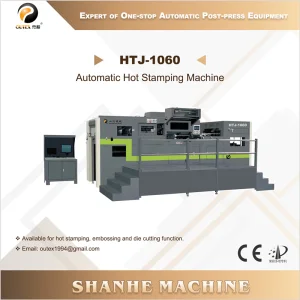
Achieving crisp foil delineation and profound emboss deboss depth requires extreme mechanical rigidity, uniform thermal dissipation, and dynamic register control. The structural foundation of SHANHE MACHINE’s flagship systems, such as the HTJ-1060 series, relies on high-tensile nodular cast iron (QT600-3) frames processed via stress-relieved anneal cycles to ensure zero frame distortion under continuous 300-ton hydraulic or toggle platen loads.
The heating plate is segmented into independently controlled heating zones (up to 12 individual PID thermal loops). Utilizing localized solid-state relays (SSR) and ceramic heating elements, temperature variance across the entire die chase is maintained within ±1°C. This eliminates cold spots, guaranteeing flawless foil release on complex holographic designs.
Featuring independent multi-shaft longitudinal and transverse foil feeding systems driven by high-torque Yaskawa servo motors. Advanced foil-saving algorithms execute micro-stepping down to 0.1mm increments, enabling foil tension stabilization even during rapid acceleration/deceleration cycles at 7,500 sheets/hour.
Lightweight, high-rigidity extruded aluminum alloy gripper bars combined with pre-stretched alloy steel drive chains guarantee long-term register integrity. The registration mechanism utilizes optical sensors and front/side pushes to realign every sheet before entering the impression zone.
The post-press finishing industry is undergoing an unprecedented digital convergence. As labor costs rise globally and skilled press operators become scarcer, packaging converters require hot foil embossing equipment that relies less on human intuition and more on artificial intelligence, automated sensor feedback, and energy-efficient thermodynamic cycles.
Future hot foil presses incorporate piezo-electric load cells underneath the platen base. Real-time algorithms continuously monitor pressure equilibrium across all four corners during production. If dynamic paper stock thickness varies, the machine autonomously adjusts platen height in 0.005mm increments to prevent foil dropouts or die wear.
With strict global directives targeting zero-plastic packaging waste, foil manufacturers are developing ultra-thin film carriers (down to 10 microns) and water-soluble release coatings. Hot foil presses must maintain extremely gentle tension control to handle delicate eco-friendly foil webs without tearing or wrinkling.
Native OPC-UA communication interfaces allow modern hot foil embossing machines to stream operational telemetry directly to plant Management Information Systems (MIS). Real-time tracking of foil usage, kilowatt-hour power consumption per 1,000 sheets, and predictive maintenance diagnostics maximize Overall Equipment Effectiveness (OEE).
Hot foil embossing machines operate at the nexus of aesthetics, structural integrity, and brand authentication. Depending on geographic market demands and sector specificities, original equipment manufacturers must tailor machinery configurations:
Requires deep-embossed textures combined with multi-color metallic foil layering on thick laminated SBS board stock. SHANHE MACHINE’s dual-action platen systems execute registered foil stamping alongside intricate micro-embossing dies in one pass, protecting high-value liquor labels and cosmetic folding cartons from counterfeiters.
Focuses heavily on uninterrupted, high-speed run lengths. Machine configurations prioritize non-stop automatic paper feeders, dual-sheet detectors, and high-speed waste foil rewinding units capable of maintaining 7,000+ sheets per hour throughput over 24/7 continuous operations.
Equipped with optical registration camera systems that align registered holographic security foils onto medicine cartons with sub-millimeter precision. The inclusion of variable data foil stamping enables anti-tamper serial numbers and brand verification marks.
Maximizing post-press efficiency requires viewing the hot foil embossing machine as a synchronized element within a comprehensive packaging line. SHANHE MACHINE’s equipment portfolio connects seamlessly upstream and downstream, eliminating material handling bottlenecks:
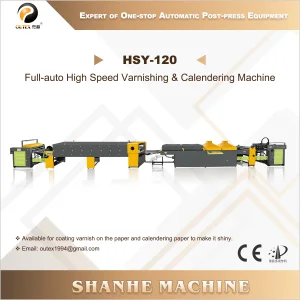
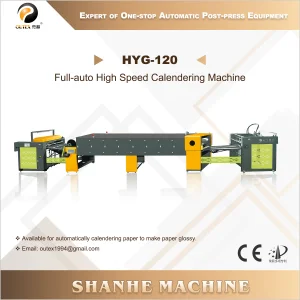
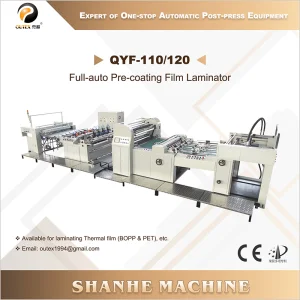
Sheets are first passed through full-auto UV coaters or high-speed varnishing and calendering machines (such as the HSY-120 line) to apply high-gloss surface protection or matte tactile coatings prior to foil stamping.
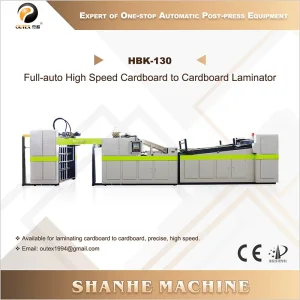
For corrugated or rigid box conversions, smart high-speed flute laminators (such as the HBF-3 Smart Flute Laminator) bind printed top liners to fluted substrates prior to deep platen embossing.
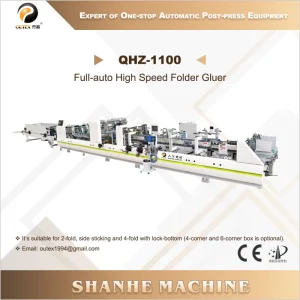
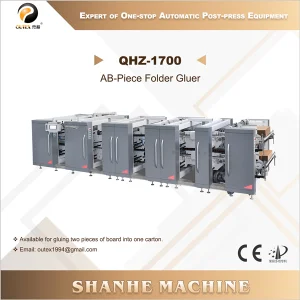
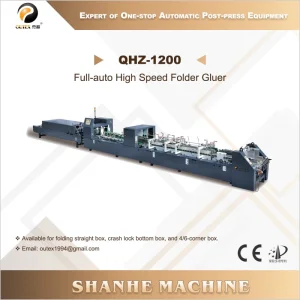
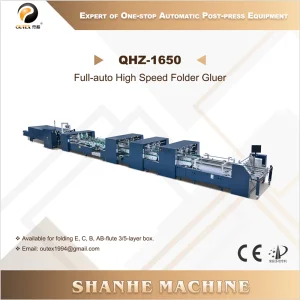
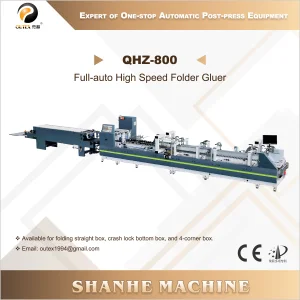
Following hot foil stamping and die cutting, stamped flat blanks move directly to high-speed folder gluers (such as the QHZ-1100 series) for folding, glue application, and automatic flip-flop stacking.