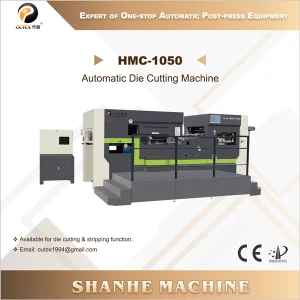
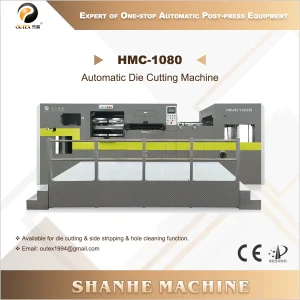
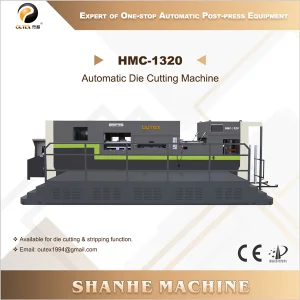
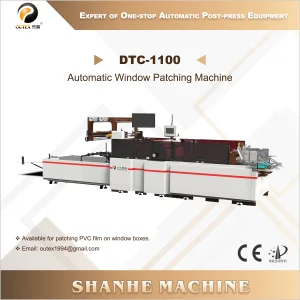
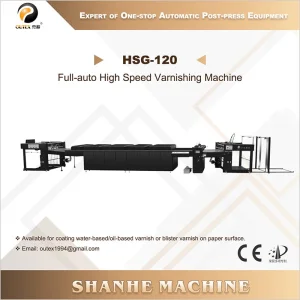
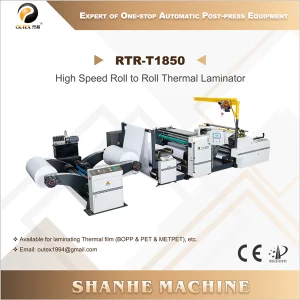
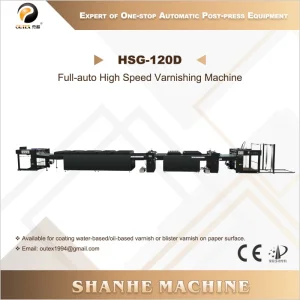
Explore our CE-compliant automatic post-press systems designed for high-precision folding, gluing, laminating, and paper handling.
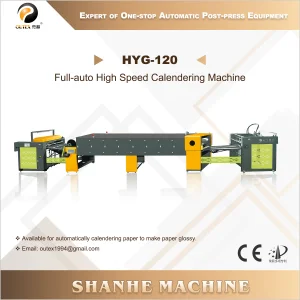
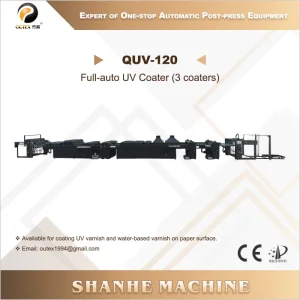
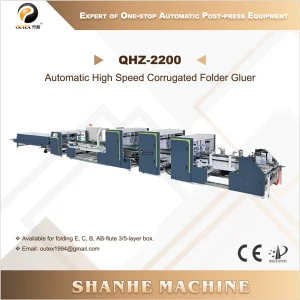
A rigorous examination of thermo-compression transfer dynamics, registration optics, and European safety standards in automated post-press finishing.
In modern industrial print finishing, the integration of high-speed surface embellishment with structural die-cutting represents the pinnacle of post-press value creation. Hot Foil Printing Machines (often operating as multi-functional hot foil stamping and die-cutting platforms) use controlled thermal energy, mechanical pressure, and precision dwell time to transfer metallic, holographic, or pigment foil films onto paperboard, corrugated flutes, and synthetic substrates.
Achieving flawless edge definition without pinholing or foil flaking requires exact thermal balancing across multi-zone honeycomb heating beds. Modern CE-certified machines employ independent PID micro-processor temperature control units (capable of maintaining constant temperatures within ±1°C across working zones up to 200°C), synchronized with multi-axis servomotor foil stepping drives to eliminate waste and optimize foil yield by up to 45%.
To legally enter and operate within the European Economic Area (EEA) and global Tier-1 manufacturing facilities, hot foil printing machinery must conform strictly to the **EU Machinery Directive 2006/42/EC**, **Low Voltage Directive 2014/35/EU**, and **Electromagnetic Compatibility (EMC) Directive 2014/30/EU**.
How packaging converters across diverse global markets utilize hot foil printing and die-cutting technology to solve specific manufacturing challenges.
Substrate: 350–450 gsm Solid Bleached Sulfate (SBS) virgin paperboard, matte laminated.
Challenge: Applying intricate micro-embossed metallic gold foil alongside fine line detail without heat halos or substrate warping.
Engineering Solution: Utilizing a dual-action platen hot stamping press featuring multi-zone PID heating, precision dwell-time control, and optical optical-mark registration. Results in crisp micro-embossing with zero register drift across 50,000 sheet runs.
Substrate: Textured cotton-blend wet-strength label stock.
Challenge: Managing high stamping pressure on porous, un-coated fibers while maintaining high speed and preventing foil bleeding.
Engineering Solution: Heavy-duty toggle-drive platen design delivering up to 300 Metric Tons of pressure combined with servomotor-driven longitudinal and transversal foil feeding. Enables deep tactile debossing and brilliant foil adhesion simultaneously.
Substrate: Pharmaceutical cartons, security tax stamps, luxury serial cards.
Challenge: Registering holographic DOVIDs (Diffractive Optically Variable Image Devices) with sub-millimeter positional tolerance.
Engineering Solution: Integrated fiber-optic sensor arrays and high-resolution optical cameras coupled with dynamic foil stepping systems. Ensures anti-counterfeiting holographic elements align perfectly to pre-printed security marks.
Substrate: E-flute and F-flute micro-corrugated board.
Challenge: Applying metallic foil accents on corrugated board without crushing internal flutes or compromising structural compression strength.
Engineering Solution: Calibrated soft-touch pressure dwell mechanisms and customized height-adjustable bed platens that apply precise surface thermal contact while protecting flute geometry.
The evolution of hot foil stamping and die-cutting technology towards Industry 4.0 connectivity, AI vision alignment, and zero-waste foil optimization.
| Technology Pillar | Legacy Post-Press Equipment | Current CE-Certified Benchmark | 2025–2030 Next-Gen Horizon |
|---|---|---|---|
| Registration Control | Manual mechanical push-side lays (Tolerance ±0.25mm) | Optical registration marks & optical fiber sensors (±0.075mm) | AI Vision CCD Real-time Closed-Loop Compensation (±0.03mm) |
| Foil Utilization & Waste | Fixed mechanical stroke stepping; high foil web waste | Programmable multi-servo motor stepping & skip-stamping drives | Dynamic Holographic Foil Saver algorithms saving up to 55% foil |
| Thermal Management | Analog single-loop heating coils; high zone variance (±5°C) | Multi-zone digital PID heating beds with thermal insulation (±1°C) | Graphene-based rapid response induction heat zones (<0.5°C variance) |
| Predictive Maintenance | Scheduled manual greasing; reactive breakdown repairs | PLC runtime diagnostics with error alarm logs | IoT Sensor Mesh analyzing vibration, lubrication & bearing wear remotely |
| Safety & Compliance | Basic emergency stops; open mechanical guards | CE Directive 2006/42/EC, PL-d safety relays & light curtains | Integrated Collaborative Safety Systems & Autonomous Feed Inspection |
Leveraging 30 years of manufacturing excellence at Guangdong Shanhe Industrial Co., Ltd. in Shantou, Guangdong, China.
Located in the heart of China's advanced machinery manufacturing cluster in Shantou, Guangdong, Guangdong Shanhe Industrial Co., Ltd. (established in 1994) operates a modern 34,175 m² facility dedicated to researching, developing, and building world-class post-press packaging equipment.
By controlling critical manufacturing processes in-house—including heavy platen casting machining, heat treatment, ultrasonic flaw detection, and gear grinding—we eliminate component tolerances and ensure ultra-stable press rigidity under heavy load.
While structural frames are precision-milled in-house, electrical and pneumatic controls utilize premium global components: Siemens PLCs, Schneider electrics, Omron photo-sensors, NSK bearings, and SMC pneumatics for seamless worldwide spare parts availability.
With independent import and export rights, SHANHE MACHINE arranges seaworthy wooden-case packing and container transport through key Chinese export ports including Shantou, Shenzhen, Guangzhou, Shanghai, and Tianjin.
Comprehensive service life-cycle protection ensuring minimal downtime and maximum operational profitability.
Purchasing industrial post-press equipment requires more than high-spec hardware; it demands complete life-cycle technical backing. SHANHE MACHINE provides a full turnkey support infrastructure for international buyers across North America, Europe, Latin America, Southeast Asia, and the Middle East:
In-depth technical answers addressing buyer inquiries regarding CE compliance, hot foil press parameters, substrate compatibility, and operational safety.
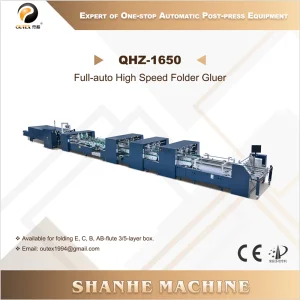
Complete your post-press production facility with our CE-certified automatic die cutters, thermal laminators, and UV coating machines.