
1. Executive Summary & Technical Scope
The global luxury packaging, tobacco, spirits, cosmetics, and anti-counterfeiting markets are undergoing a significant technological shift toward multi-process inline embellishment. To achieve visual distinction, brand protection, and sensory tactile depth, packaging converters require advanced post-press machinery capable of applying multiple foil layers, micro-embossing, and combined tactile textures in a single pass.
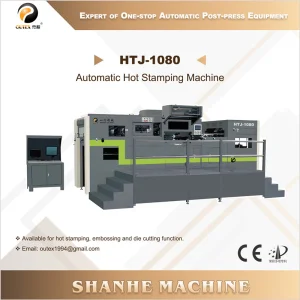
An Automatic High Speed Double Hot Stamping Machine represents the pinnacle of post-press machinery engineering. By integrating two sequential hot stamping stations (dual-station or double-tower design) into a high-speed platen die-cutting platform, these units allow converters to execute complex dual-color foil stamping, combination foil-embossing, or inline foil-stamping plus holographic security positioning at rated speeds up to 8,000 sheets per hour.
This technical whitepaper examines the engineering architecture, manufacturing capabilities, economic benefits, and strategic procurement frameworks associated with sourcing Automatic High Speed Double Hot Stamping Machines from premier Chinese OEM/ODM suppliers such as Guangdong Shanhe Industrial Co., Ltd. (SHANHE MACHINE).
Dual Station Foil Feeding
Independent longitudinal & transverse multi-shaft servo foil stepping systems reducing foil waste by up to 45%.
Ultra-Heavy Platen Structure
High-grade nodular cast iron base and platen capable of sustaining continuous 600-ton impression force.
Smart Thermal Management
Multi-zone PID heating honeycomb plates with micro-degree thermal stability across 1050mm x 750mm formats.
Holographic Registration
High-precision optical sensors for security holographic film positioning with ±0.075mm registration tolerance.
2. Double Hot Stamping Machine Architecture & Engineering Innovations
Conventional hot foil stamping requires multiple passes through single-station machinery when applying complex graphic designs—such as dual metallic foils (e.g., gold and silver simultaneously), or combining flat foil stamping with deep multi-level embossing. Multi-pass processing introduces catastrophic registration error, paper dimensional instability (due to repeated heat application), and ballooning labor costs.
2.1 Dual Platen vs. Dual Foil-Feed Station Architecture
When searching for top China Automatic High Speed Double Hot Stamping Machine Suppliers & Companies, prospective buyers must distinguish between two primary mechanical configurations:
- Dual-Platen Twin-Tower Systems: Feature two separate, synchronized heavy-duty toggle impression platens in series. Station A executes primary foil stamping (or deep embossing), while Station B executes secondary foil stamping or fine die-cutting. This configuration provides maximum impression tonnage (up to 600T per station) and zero thermal interference between different foil types.
- Single-Platen Multi-Axis Dual-Foil Systems: Utilize a single massive impression platen equipped with dual, independently driven foil feed tracks (longitudinal and transverse) operating over distinct heating zones. While physically more compact, single-platen variants require extremely rigid bed structures to prevent deflection when unequal stamping forces are applied across different sections of the sheet.
2.2 High-Precision Servo Foil Stepping & Waste Optimization
Foil represents the highest ongoing operational expense in luxury post-press conversion. State-of-the-art Chinese automatic high-speed double hot stamping machines incorporate multi-axis servo motor systems (often 6 to 12 independent shafts) controlled by motion-control CPUs. Advanced algorithms execute irregular foil stepping—advancing the foil ribbon only the exact distance required by the image geometry, regardless of sheet length.
Furthermore, internal foil rewind systems feature automatic tension calculation based on roll diameter decay, eliminating foil breaks during acceleration cycles up to 8,000 sheets/hour.
Dual-Pass Foil Economy
Saves up to 45% on metallic and holographic foil costs via intelligent step-and-repeat foil advancing software.
Thermal Stability Zone
12-zone individual PID heating plate ensures zero temperature drop across extended 24-hour high-speed production runs.
OEE Yield Acceleration
Reduces setup times by 50% compared to traditional single-station multi-pass setups, boosting Overall Equipment Effectiveness.
3. Strategic Advantages of Sourcing Double Hot Stamping Machines from China
China has established itself as the global epicenter for advanced post-press equipment engineering, with dedicated industrial manufacturing clusters such as Shantou in Guangdong Province. Sourcing high-speed double hot stamping machinery from leading Chinese suppliers provides undeniable commercial and technological advantages:
3.1 Complete Industrial Supply Chain Infrastructure
The concentration of precision CNC machining centers, specialized metallurgy foundries, and motion-control software firms in Guangdong enables Chinese manufacturers to build ultra-rigid machine frames using high-tensile nodular cast iron (QT600-3). This heavy castings foundation absorbs dynamic vibration during continuous high-impact stamping cycles.
3.2 Superior Price-to-Performance & Total Cost of Ownership (TCO)
European post-press equipment often comes with prohibitive capital investment costs and expensive long-term spare parts pricing. Leading Chinese suppliers offer double hot stamping machines engineered with premium international components (NSK bearings, Schneider electronics, Yaskawa/Panasonic servo drives, Omron sensors) at 40% to 60% lower capital expenditure, delivering rapid ROI within 12 to 18 months.
3.3 Deep Customization & Modular Engineering
Unlike rigid off-the-shelf Western models, top Chinese manufacturers actively collaborate with international packaging converters to engineer bespoke configurations. Options include inline deep embossing attachments, extended feeder/delivery piles, integrated strip-clearing stations, and customized foil ribbon rewinding geometries tailored to specific tobacco or luxury spirit box formats.
4. Technical Benchmark: Double Hot Stamping Machine vs. Traditional Single Stamping
| Performance Indicator | Automatic Double Hot Stamping Machine | Single Station (Dual Pass Required) | Operational Advantage |
|---|---|---|---|
| Production Pass Rate | 1 Pass (100% Inline Completion) | 2 Separate Passes | Eliminates paper re-feeding & double handling |
| Registration Tolerance | ±0.075 mm (Fixed Mechanical Alignment) | ±0.25 mm (Sheet Humidity Deformation) | Superior quality on micro-text foil registration |
| Max Operating Speed | 7,500 – 8,000 sheets/hour | 4,500 – 5,500 sheets/hour (x2 runs) | More than 250% throughput gain |
| Substrate Thermal Stress | Single Thermal Exposure | Repeated Thermal Exposure | Prevents paper curl, warping, and cracking |
| Foil Waste Rate | 5% - 8% (Multi-step Servo Optimization) | 15% - 25% (Standard Stepping) | Significant raw material cost reduction |
5. Industry 4.0 Integration & Future Technological Trends
As smart manufacturing principles reshape global supply chains, Chinese post-press machinery manufacturers are embedding advanced digital and automation technologies into their double hot stamping lines:
- AI-Assisted Optical Registration & Vision Inspection: Inline camera systems monitor foil transfer quality in real-time, instantly identifying pinholes, mis-registration, or incomplete foil adhesion at full production speeds. Defects are automatically flagged or diverted at the delivery stacker.
- IoT Predictive Maintenance Diagnostics: Vibration sensors on main drive shafts, thermal telemetry on heating plates, and pneumatic pressure transducers transmit continuous diagnostic telemetry to cloud dashboards, preventing unexpected downtime.
- Energy-Efficient Thermal Insulation Systems: Advanced nano-ceramic thermal barriers between heating plates and main platens minimize energy losses, reducing overall power consumption by up to 22% compared to legacy designs.
- Non-Stop High-Pile Feeder and Delivery Systems: Motorized non-stop curtain systems allow continuous substrate feeding and pile swapping without pausing machine rotation, maximizing net operating hours.
6. Target Application Scenarios & Sector Solutions
The deployment of high-speed double hot stamping machinery is essential across several demanding market sectors:
6.1 Premium Tobacco & Spirits Packaging
High-end cigarette cartons and spirit boxes require complex anti-counterfeiting elements, including registered holographic images, metallic micro-engraving, and deep embossed brand crests. Double hot stamping machines apply security holograms at Station 1 and metallic foil framing at Station 2 with exact synchronization.
6.2 Luxury Cosmetics & Perfume Folding Cartons
Cosmetic folding cartons frequently combine matte background foil with ultra-glossy gold text highlights. Executing both stamping effects inline eliminates color contamination and ensures immaculate surface aesthetics on delicate coated paperboards (250–500 gsm) or laminated substrates.
6.3 Pharmaceutical & Anti-Counterfeiting Packaging
Pharmaceutical packaging regulations demand stringent security measures. Double hot stamping machinery allows inline application of overt security foils combined with tactile Braille embossing in a single controlled process.
7. Global Procurement & Supplier Evaluation Guide
When evaluating China Automatic High Speed Double Hot Stamping Machine Suppliers & Companies, procurement managers should follow a comprehensive technical checklist during factory audits:
- Mechanical Weight & Structural Castings: Verify that the total machine weight reflects heavy-duty construction (typically >18 to 25 tons for 1050 format double-station machines). Lighter frames indicate reduced casting density, leading to premature frame flex under 600-ton pressures.
- Precision Machining Standards: Audit the supplier’s internal machine shop. Leading manufacturers like Guangdong Shanhe Industrial Co., Ltd. utilize high-precision five-axis CNC machining centers to process key components in-house.
- Thermal Heating Plate Grid Density: Request technical schematics showing heating zone breakdown. A minimum of 12 to 16 independently controlled PID zones is required for uniform heat distribution across 1050mm spans.
- CE Certification & Safety Interlocks: Ensure compliance with international safety standards, including dual-circuit safety relays, light curtains at feeder/delivery zones, and CE-marked electrical enclosures.
- After-Sales Global Support Infrastructure: Confirm availability of remote diagnostic interfaces, multi-lingual technical documentation, spare parts kits, and on-site engineering support.