
In the global post-press packaging and commercial printing sector, China card stamping machine companies have evolved from budget machine assemblers into leading pioneers of high-precision, servo-driven, and AI-integrated hot foil stamping equipment. Modern post-press production demands unprecedented levels of registration accuracy, thermal stability, foil-saving capabilities, and operational throughput.
Whether producing luxury folding cartons, high-security financial smart cards, anti-counterfeiting pharmaceuticals packaging, or premium gift boxes, international buyers require machinery that pairs heavy tonnage pressure (such as 600-ton platen capacity) with microscopic alignment accuracy (+/- 0.075 mm). Leading original equipment manufacturers (OEMs) based in key Chinese manufacturing clusters—most notably Guangdong, Shantou, and Zhejiang—are setting new benchmarks for total cost of ownership (TCO) and operational longevity.
Conventional mechanical stamping machines suffer from significant foil overlap and excessive material waste. Modern Chinese card stamping machines utilize independent multi-servo motor drives for foil tension control and stepping algorithms. This technology enables complex holographic positioning, micro-stepping, and automatic foil recalculation, drastically cutting consumable overhead for high-volume packaging runs.
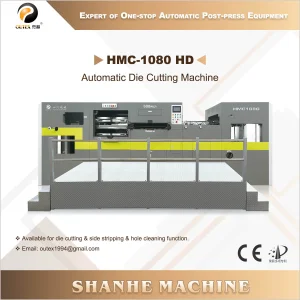
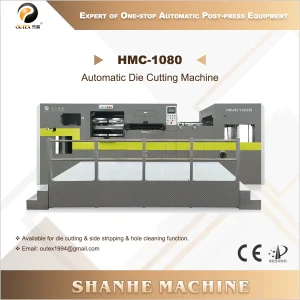
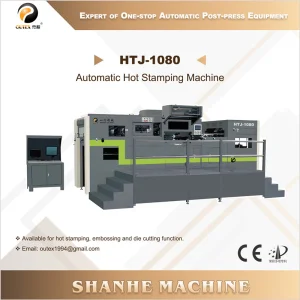
Structural stability dictates precision when foil stamping thick paperboard, solid bleach sulfate (SBS) board, or plastic card substrates (PVC, PET, ABS). Utilizing stress-relieved nodular cast iron frames engineered via Finite Element Analysis (FEA), machines like the HTJ and HMC series withstand up to 600 Tons of cutting and stamping force without chassis distortion.
Hot foil transfer requires exact thermal activation of foil adhesive layers. Advanced heating systems incorporate up to 12 or 16 independently controlled digital heating zones. Coupled with ceramic heating elements and real-time thermistor feedback, the system guarantees dynamic heat distribution (+/- 1°C variance) across the entire honeycomb plate surface.
| Performance Parameter | Standard Card Stamping Model | Heavy-Duty Industrial Stamping Model | Ultra-High Precision Holographic Model |
|---|---|---|---|
| Maximum Sheet Size | 750 x 560 mm | 1080 x 780 mm | 1450 x 1080 mm |
| Stamping & Cutting Force | 150 - 250 Tons | 300 - 600 Tons | 400 - 650 Tons |
| Max Stamping Speed | 6,000 sheets/hour | 7,500 sheets/hour | 8,000+ sheets/hour |
| Registration Accuracy | ± 0.10 mm | ± 0.075 mm | ± 0.050 mm (AI-Optical) |
| Substrate Compatibility | Paperboard 90–600 g/m² | Cardboard, Corrugated B/E/F flute | Plastic PVC/PET cards, Micro-flute, Rigid Board |
| Heating System | 4 - 8 Multi-zone PID | 12 Independent Thermal Zones | 16 Zone Digital Smart Thermal Array |
Industrial clusters in Guangdong (such as Shantou's Jinping Industrial District) consolidate precision CNC machining shops, electrical component suppliers, casting foundries, and assembly plants within a 50-kilometer radius. This proximity drastically reduces manufacturing lead times and component acquisition costs.
By leveraging high-volume component procurement and streamlined engineering workflows, Chinese manufacturers offer high-end post-press equipment at 40% to 60% less capital expenditure compared to European counterparts, without compromising critical performance or safety standards.
Global card producers and packaging converters often require specialized sheet dimensioning, inline stripping units, vertical stackers, or custom foil reel holders. Chinese companies excel at fast-turnaround mechanical re-engineering to fit precise plant layouts and substrate parameters.
Quantifiable metrics reflecting China's leading post-press production ecosystems.
Investing in heavy post-press machinery requires rigorous validation of international safety and operational compliance. Leading Chinese machinery exporters adhere strictly to European Union Safety Directives (CE marking), ISO 9001 quality frameworks, and OSHA compliance guidelines.
Key safety implementations on top-tier automatic card stamping machines include multi-beam infrared safety light curtains, pneumatic clutch-brake interlocks, dual-circuit emergency stop systems, and soundproof protective enclosures.
Rigorous 72-hour continuous operation run under full speed and load with customer-supplied stock.
Custom step-up/step-down transformers to accommodate 220V, 380V, 415V, or 480V 3-Phase power grids worldwide.
Heavy-duty vacuum foil wrapping, anti-rust grease application, and reinforced ISPM-15 compliant wooden sea crates.
Structured hands-on training for plant operators covering makeready optimization, die mounting, and preventive maintenance schedules.
Precision hot stamping of signature panels, magnetic strips, and security hologram foils on PVC, PETG, and Polycarbonate financial credit cards, ID cards, and transit passes requiring strict registration tolerances (+/- 0.05 mm).
Deep 3D tactile embossing combined with multi-color metallic foil stamping on rigid premium cartons, perfume boxes, and high-end liquor packaging designed for maximum shelf visibility and brand anti-counterfeiting.
High-speed, defect-free embossing of Braille lettering alongside micro-fine security foil stamping on pharmaceutical cartons, ensuring compliance with global healthcare packaging directives.
Next-generation card stamping machines integrate high-resolution CCD camera vision modules. These systems inspect sheet-by-sheet registration, detect foil pinholes, flag missing stamp areas, and reject defective cards in real-time at operational speeds exceeding 7,500 sheets/hour.
Automated honey-comb plate positioning and motorized registration pins allow operators to save die configurations digitally. Recalling job presets reduces job setup time from hours down to under 15 minutes, significantly lowering substrate scrap during makeready.
With environmental regulations emphasizing recyclability, Chinese manufacturers are developing hybrid presses capable of both hot foil stamping and inline cold foil transfer, eliminating plastic carrier film residues while maintaining high reflective brilliance.
While standard die-cutting machines focus primarily on cutting, creasing, and stripping sheet substrates, an automatic card stamping machine (hot foil stamper) is equipped with heated platens (up to 160°C–200°C), multi-zone thermal controllers, and servo-driven foil feed/rewind mechanisms. Stamping machines can perform both hot foil transfer and die-cutting/embossing—either in a single pass or as separate functions.
Top Chinese manufacturers achieve registration tolerances of ± 0.075 mm or tighter by integrating high-precision optical sensor front-lays, side-lays, dynamic servo-driven push-guides, and heavy-duty cast iron frames. Furthermore, micro-metric adjustments on the platen bed allow fine-tuning during operational runs.
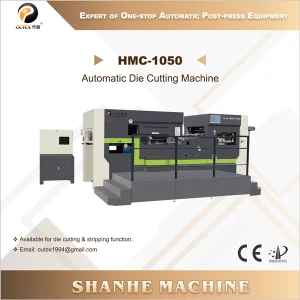
Machines such as the HTJ-1080 and HMC series accommodate a vast array of materials, including SBS paperboard (90 to 600 g/m²), laminated cardboard, rigid chipboard, plastic card sheets (PVC, ABS, PET, Polycarbonate), and micro-flute corrugated cardboard (E, F, N flutes up to 4mm thickness).
Traditional mechanical stepping moves foil by a fixed length regardless of the stamped graphic size, resulting in massive foil waste. A multi-axis servo foil saver independently advances multiple foil rolls only by the precise length required for each die impression. It can perform micro-stepping and skip-stepping over non-printed gaps, saving up to 40% to 50% in foil consumption.
You should verify that the supplier holds ISO 9001 quality management certification and CE Certification under the European Machinery Directive 2006/42/EC and Low Voltage Directive 2014/35/EU. Safety hardware should include double-safety circuit relays, emergency stop switches, and optical safety curtain protection.
Standard model configurations typically have a factory manufacturing cycle of 30 to 45 days. For specialized OEM/ODM orders requiring expanded sheet formats, custom foil reel stands, or integrated stripping units, lead time ranges between 60 to 75 days including Factory Acceptance Testing (FAT).
Manufacturers dispatch qualified mechanical and electrical engineers directly to your plant to supervise uncrating, position setting, power connection, leveling, and dry-run calibration. The installation package includes 5 to 7 days of comprehensive operator training covering die setup, thermal profile optimization, safety protocols, and daily maintenance schedules.
Routine maintenance includes daily cleaning of the platen bed and optical sensors, automated central lubrication checks for main toggle drives, monthly tension checks on gripper chains, and periodic thermal sensor calibration on the heating zones. Following the factory SLA ensures decades of reliable performance.
Work directly with China's leading post-press equipment manufacturers. Get engineered quotes, technical catalog specifications, or schedule an in-person factory tour in Shantou, Guangdong, China.