
The Evolution of Hot Stamping Machinery: From Kingsley Benchtop Craftsmanship to Industrial Automation
Analyzing technical transitions, thermodynamic precision, platen pressure mechanics, and global purchasing dynamics in modern foil embellishment.
Key Takeaway & Executive Summary
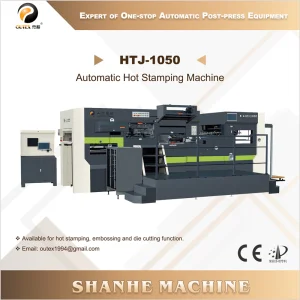
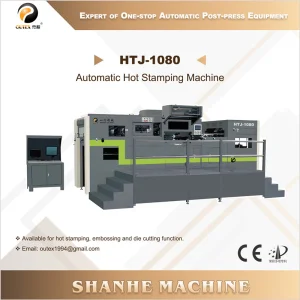
While the term "Kingsley Hot Stamping Machine" historically defined tabletop hot foil stamping for leather craft, bookbinding, and manual monogramming, the modern global print and packaging industry has evolved toward high-speed, automated, continuous-feed platen stamping systems. Modern manufacturers like Guangdong Shanhe Industrial Co., Ltd. (SHANHE MACHINE) bridge this heritage of precision with heavy-duty industrial scale, providing automatic hot stamping solutions (such as the HTJ-1080 and HTJ-1050) capable of processing thousands of sheets per hour with sub-millimeter foil transfer accuracy.
1. Historical Context: Legacy Kingsley Systems vs. Modern Industrial Hot Stamping
For decades, the Kingsley name was synonymous with foil transfer stamping. Originally developed for small-format customization, manual Kingsley hot stampers utilized handheld type holders, basic heating elements, and mechanical pull-levers. These machines served niche markets such as customized stationery, leather monograms, and small specialty foil prints.
However, as global consumer product goods (CPG), luxury packaging, pharmaceutical security, and cosmetics sectors expanded, market demand shifted dramatically. Modern converting plants required high-throughput systems capable of handling large sheet sizes (up to 1080 mm × 780 mm), multiple foil rolls, micro-embossing, and complex holographic security registration at production speeds exceeding 6,000 sheets per hour.
| Engineering Attribute | Legacy Kingsley-Style Systems | Modern Industrial HTJ Series (SHANHE) |
|---|---|---|
| Operation Mode | Manual lever / Semi-automatic benchtop | Fully automatic feeder, PLC control, continuous inline |
| Max Platen Tonnage | 0.5 to 2 Tons (Hand/Pneumatic) | 300 to 600 Tons (Cast Iron Heavy Frame) |
| Sheet Speed | 100 – 300 cycles/hour (Manual feed) | 5,000 – 7,500 sheets/hour (Continuous feeder) |
| Temperature Zones | Single analog thermal element | Multi-zone digital PID thermal control (Independent) |
| Foil Feeding | Single mechanical foil advance | Multi-axis servo-driven longitudinal & transverse stepping |
| Primary Application | Leather Monogramming, Personalized Gifts | High-Volume Folding Cartons, Cosmetics, Wine & Tobacco |
2. Thermodynamic Precision & Pressure Mechanics in High-Quality Hot Stamping
Achieving flawless foil transfer—whether bright metallic aluminum, matte pigment, or diffraction holograms—depends on three critical engineering variables: Pressure, Temperature, and Dwell Time.
A. Multi-Zone Thermal Heating Systems
Substrate distortion and uneven foil transfer are primary causes of post-press scrap. Advanced industrial hot stamping machines utilize independent multi-zone heating plates. Each zone is governed by PID temperature control microprocessors capable of maintaining precise heat variances within ±1°C. This prevents thermal hot-spots and ensures that large-area solid foils release cleanly alongside intricate micro-text foil elements.
B. Platen Tonnage and Structural Rigidity
Under heavy stamping pressures (often exceeding 300 tons), inferior machine frames experience micro-flexing. Micro-flexing causes pressure drops at the center of the sheet, resulting in incomplete foil transfer or patchy embossing. High-quality manufacturers employ high-tensile nodular cast iron for machine beds and platens, stress-relieved through heat treatment to guarantee zero deflection under maximum load.
C. Multi-Axis Servo Foil Pulling Technology
Foil raw material accounts for a significant portion of post-press operating expenditure. Modern industrial machinery integrates independent multi-axis servo drives for foil feeding. These algorithms calculate foil stepping lengths dynamically, enabling long and short foil pulls within the same sheet cycle. This technology reduces foil waste by up to 30–35% compared to legacy mechanical stepping systems.
3. Global Market Landscape & Chinese Manufacturing Advantages
The global market for hot stamping packaging machinery is expanding rapidly, driven by the growth of luxury retail, premium spirit packaging, and anti-counterfeiting requirements in global pharmaceutical markets. Packaging converters in North America, Europe, Southeast Asia, and the Middle East are actively modernizing their post-press infrastructure.
30+ Years Industry Heritage
Founded in 1994 in Shantou, Guangdong Shanhe Industrial Co., Ltd. brings three decades of specialized post-press machinery engineering experience to global buyers.
34,175 m² Industrial Base
Our integrated manufacturing cluster houses advanced CNC machining centers, automated assembly workshops, and stringent pre-shipment testing bays.
Global Export Supply Chain
Holding direct import/export rights, SHANHE exports directly to global converters, backed by international trade show presence (DRUPA Germany, India Color Box, etc.).
Chinese machinery manufacturers have established a distinct global advantage by offering high structural durability, premium electrical component integration (Siemens, Schneider, Omron PLC & servo drives), and CE-compliant safety standards at a total cost of ownership (TCO) significantly lower than traditional European brands. This allows packaging plants to achieve full ROI within 18–24 months of installation.
4. Localized Application Scenarios in Modern Packaging
High-quality automatic hot stamping machines are deployed across diverse sectors to increase product shelf appeal, brand awareness, and product authenticity:
- Luxury Cosmetic Packaging: Applying metallic gold, silver, and rose-gold foil embellishments on solid bleached sulfate (SBS) board, combined with blind deep embossing for premium feel.
- Spirits, Wine & Tobacco Cartons: Multi-color foil stamping and tactile micro-embossing on laminated board to produce eye-catching duty-free packaging.
- Pharmaceutical & Security Documents: Precise transfer of registered optical variable devices (OVD) and anti-counterfeiting holographic foils onto prescription drug boxes.
- High-End Greeting Cards & Book Covers: Large-surface solid foil stamping combined with precision die-cutting in single or dual-pass finishing lines.
5. Key Technical Criteria for Global Machinery Procurement
When selecting an industrial automatic hot stamping machine to upgrade from legacy Kingsley-style or manual systems, enterprise purchasing directors should evaluate five foundational factors:
- Feeder Mechanism & Non-stop Delivery: Ensure suction feeder heads handle range of paper stock (90 gsm paper up to 2000 gsm cardboard, or E/B flute corrugated board).
- Registration Accuracy: Look for optical sensors and side lays capable of maintaining sheet registration tolerances within ±0.075 mm.
- Holographic Foil Feeding Options: Verify that machine software supports optical eye registration for registered pattern security foils.
- Safety Compliance: Ensure full CE compliance with dual-circuit safety interlocks, light curtains, and emergency braking systems.
- After-Sales Technical Lifecycle: Confirm manufacturer provides remote diagnostics, readily available spare parts, and on-site engineering installation support.