Engineered for folding carton converters, packaging specialists, and commercial print finishers requiring microscopic registration, rapid changeovers, and durable mechanical resilience.



Evaluating market transitions toward haptic brand differentiation, high-throughput inline polymerization, and sustainable photopolymer resins in packaging manufacturing.
Global brand owners in cosmetic, spirit, and consumer electronic sectors leverage selective Spot UV to elicit neuro-tactile responses. Scientific eye-tracking and neuromarketing studies demonstrate that regional tactile contrast (combining super-matte laminates with 95+ GU specular high-gloss coatings) extends retail shelf engagement by up to 240% compared to flat prints.
Legacy manual screen printers fail to keep pace with contemporary high-volume folding box presses. Today's industrial spot coaters must sustain mechanical velocities between 6,000 and 10,000 sheets per hour without micro-splattering or misregistration. Continuous rotary screen and specialized offset-blanket spot coaters provide the engineering bridge between fine embellishment and volume commercial output.
Energy conservation is transforming post-press machine selection. The migration from standard medium-pressure mercury lamps to targeted LED-UV arrays and hybrid cold-curing chambers reduces pressroom power consumption by 40% to 65%. Furthermore, automated varnish circulation and anilox metering cut expensive photoinitiator and polymer coating waste to negligible fractions.
An architectural breakdown of sheet-fed varnishing machinery, including vision-guided registration, rheology control, and multi-wavelength photopolymerization.
High-speed spot coating on pre-printed lithographic or digital substrates requires constant compensation for paper expansion, hygroscopic deformation, and guillotine variance. Leading spot UV units deploy high-frequency linear CCD matrix sensors paired with independent front-lay and side-lay servo motors, delivering on-the-fly correction at micron scales.
While flexographic photopolymer plates (photopolymer sleeves mounted with compressible cushion adhesive) excel at micro-relief dots, intricate lines, and high web speeds, rotary nickel screens allow heavy ink deposits from 15 to 80 microns. This flexibility is vital for braille tactile warnings and 3D textured tactile finishes without solvent pinholing.
Complete monomer-to-polymer crosslinking relies on balanced UV radiation. Dual-wavelength designs combine 395nm UV-LED arrays for deep resin pinning with multi-spectral medium-pressure mercury lamps (200–450nm) to cure surface oxygen-inhibited layers, achieving scratch resistance without thermal substrate warpage.
| Feature Parameter | Rotary Screen Spot UV | Flexo Cylinder Spot UV | Digital Inkjet Spot UV |
|---|---|---|---|
| Maximum Coating Speed | 4,500 – 6,500 SPH | 7,500 – 10,000 SPH | 1,200 – 3,000 SPH |
| Coating Thickness (Deposit) | 12 μm to 90 μm (High 3D Tactile) | 2.5 μm to 14 μm (Smooth Gloss) | 10 μm to 120 μm (Variable) |
| Setup Time & Tooling Cost | Moderate (Screen preparation) | Low-to-Medium (Flexo plate) | Zero Tooling (Direct RIP data) |
| Substrate Grammage Range | 120 gsm – 600 gsm | 80 gsm – 550 gsm | 135 gsm – 500 gsm |
| Optimal Production Run | Medium to Long Runs (5,000+) | Large Scale (20,000 to 500,000+) | Ultra Short Run / Personalized (1–2,000) |
Across global industrial centers, selective varnishing enhances brand value, satisfies strict regulatory requirements, and builds tamper-evident security packaging.
Premium folding cartons require combinations of soft-touch matte lamination, hot foil stamping, and high-build spot UV patterns. Accurate layer-to-layer registration keeps the gloss varnish aligned with cold or hot stamping foils without edge bleeding, achieving crisp optical contrast and high surface integrity under friction.
Under European standard EN 15823 and international pharma guidelines, tactile dots must maintain precise heights (minimum 0.20 mm) through transit. High-build spot UV screen coating deposits controlled polymer droplets for tactile dots, eliminating mechanical embossing dies while allowing variable serialization.
Rigid gift boxes for smartphones and consumer electronics use gloss UV accents on deep black backgrounds. Spot UV formulations must offer flexibility to prevent micro-cracking when folded along structural scoring lines on 400+ gsm bleached sulfate (SBS) board stocks.
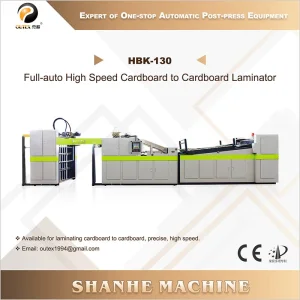
Guangdong Shanhe Industrial Co., Ltd. builds synchronized finishing systems that connect precision spot coating directly to automated die-cutting, lamination, and gluing lines.
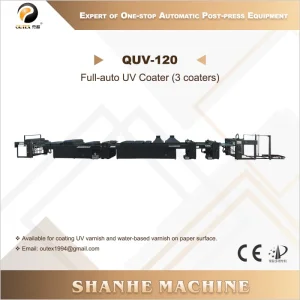
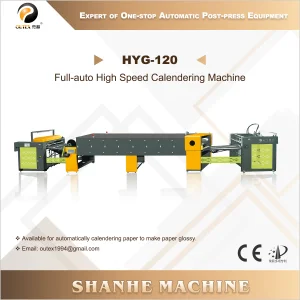
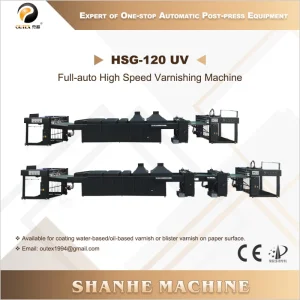
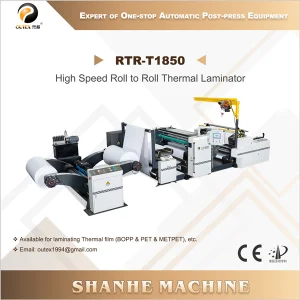
Pairing our QUV and HSG coating series with inline film or thermal laminators (such as the RTR-T series) prepares substrates for targeted spot coats. Calendering smoothens surface fibers, ensuring uniform surface energy (38+ dynes/cm) and strong varnish adhesion without pinholes.
Spot UV coated sheets transition directly to our HMC-930/1500 and HMC-1700 automated platen die-cutters. Reliable non-contact sheet transport prevents scuffing on delicate high-gloss finishes, while deep-embossing configurations (HMC-1080DE, 650 Tons) create multi-level tactile effects in a single pass.
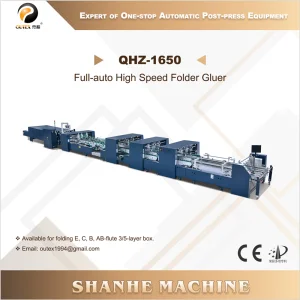
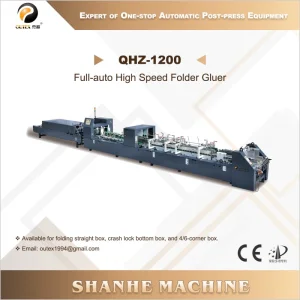
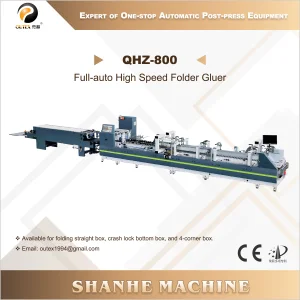
Where high-gloss spot UV meets box glue flaps, adhesion failure can occur. In Shanhe's QHZ folder gluer workflows, cold-plasma guns oxidize surface varnishes on glue tabs, creating strong molecular bonds with water-based PVA adhesives and keeping carton production lines running at high output.
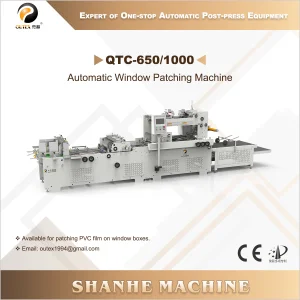
Explore our full line of spot coaters, dual-channel window patchers, heavy-duty foil stampers, and roll-to-roll laminators designed for long-term production reliability.



Detailed technical answers covering substrate surface dynamics, mechanical register tolerances, chemical curing parameters, and plant integration.
While flood varnishing coats 100% of the sheet for protection against moisture and abrasions, spot UV uses relief plates or screens to apply varnish only to specified graphic elements (such as logos, hero visuals, or tactile accents). This creates strong gloss-matte visual contrast, saves varnish volume, and keeps glue tabs free of coatings that could compromise adhesive bonding.
For reliable wetting and adhesion of UV curable varnishes without orange peel or reticulation, base substrates (or BOPP/PET thermal films) should maintain a surface tension of at least 38 dynes/cm, with 40 to 42 dynes/cm preferred. If tension drops below this range, corona treatment or targeted inline primer applications are recommended prior to spot coating.
Shanhe machinery uses dual optical sensors and linear CCD matrix cameras paired with high-torque servo drives. The vision system tracks either sheet edges or printed register marks, adjusting front and pull lays dynamically to maintain registration within ±0.05 mm across varying ambient room moisture conditions.
Typical radical-type UV varnishes running at 6,000 to 9,000 sheets/hour require integrated UV energy densities between 50 and 120 mJ/cm² across UVA, UVB, and UVC bands. Our curing tunnels pair high-output mercury arc lamps (80–120 W/cm) or solid-state UV-LED banks with chill rollers to protect heat-sensitive thin stocks from curling.
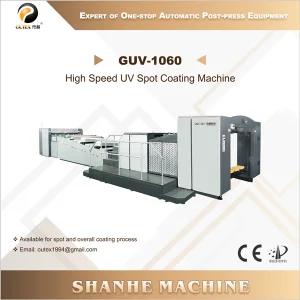
Yes. By using rotary screen cylinders (such as on our specialized GUV series) or heavy-deposit flexo configurations, converters can achieve film builds from 25 μm up to 100+ μm in a single pass. This deposit thickness reliably meets European pharma standards for raised dots without requiring mechanical male/female embossing dies.
We recommend cleaning the doctor blade chamber and washing anilox cells with ultrasonic cleaning fluids weekly to prevent dried polymer buildup. Check UV lamp reflectors and run UV radiometer tests every 500 operating hours. Our integrated touchscreens include automated alerts for lubrication cycles and pneumatic line checks.
给我发一封邮件,我会尽快回复你。
发送邮件